Honeycomb cells that hold a pocket of air against the glass — the one window covering that does real work on a July afternoon and a January night. Light-filtering through room-darkening, cordless wherever children or pets can reach. Free in-home estimate anywhere in the Treasure Valley.
Look at a cellular shade end-on and you will see rows of little six-sided tubes running the width of the window, like a honeycomb turned sideways. Each one of those cells is sealed air. That is the entire idea, and it is the reason this is the only shade on our list that is sold on what it does rather than on what it looks like.
Air is a poor conductor of heat. A single sheet of glass is a good one. Put a row of trapped air pockets between the two and you have slowed the handoff in both directions — heat trying to get in during the summer, heat trying to get out in the winter. Nothing exotic is happening. It is the same principle as a double-pane window or a puffy coat, applied to a window covering.
People sometimes confuse these with pleated shades, which look similar from the front. A pleated shade is one layer of fabric folded like an accordion. A cellular shade is two layers bonded together so the folds form closed cells. From across the room they are hard to tell apart. From an energy standpoint they are not the same product at all. See the rest of our shade range.
Get a cellular shade quote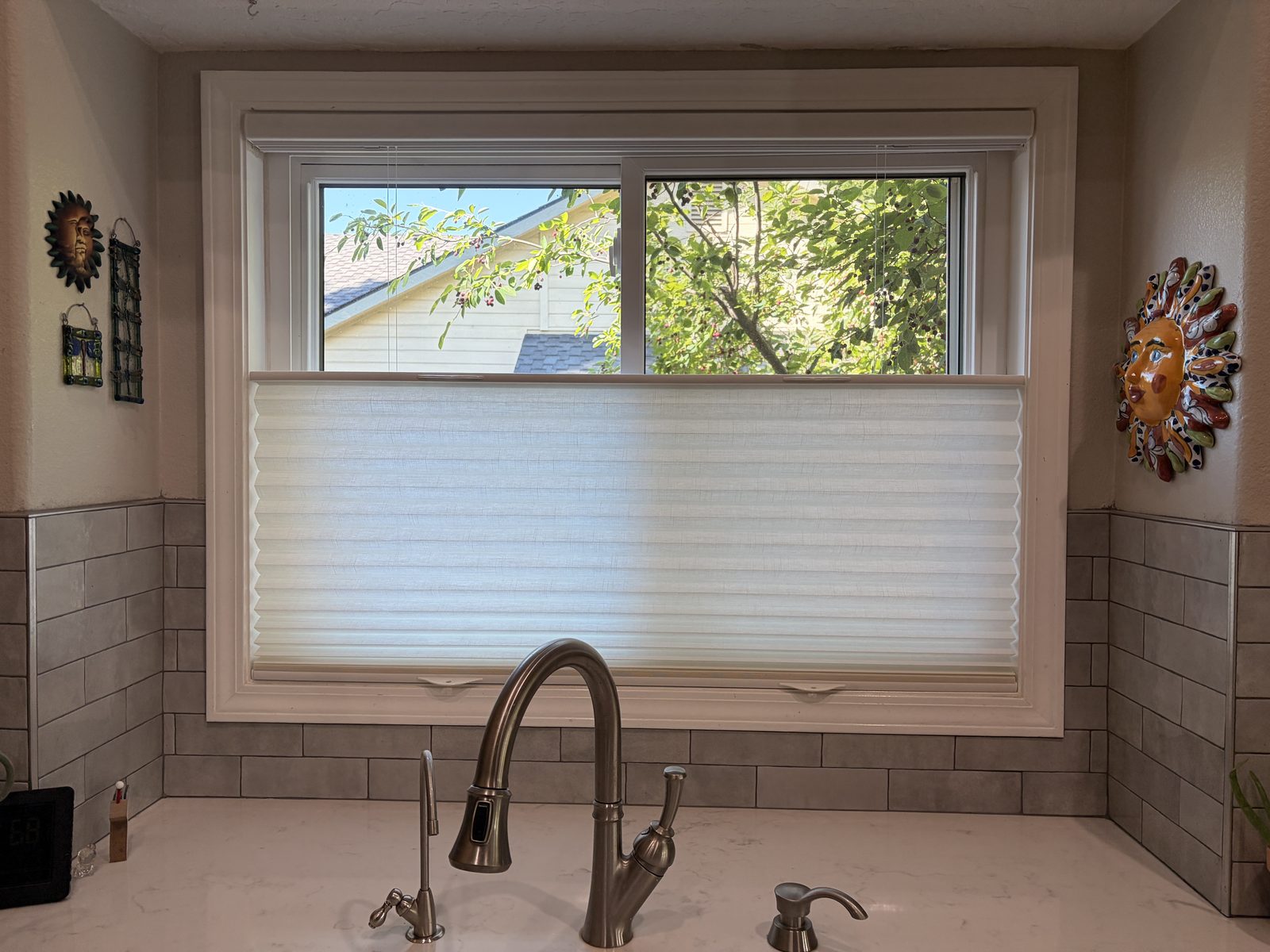
Three specification choices that sound technical and are actually easy once somebody explains them at your window. They change performance more than the color does.
One row of cells. Lighter, stacks tighter at the top of the window so you lose less glass when it is raised, and it is the simpler thing to operate. It still insulates meaningfully. On most windows in a reasonably tight modern house, this is the sensible answer and you are not giving up much.
A cell inside a cell, so two pockets of trapped air instead of one. More insulating value, a slightly deeper stack, a little more fabric. Worth it on the windows that actually hurt — a west-facing wall of glass, a room over the garage, an older window nobody is about to replace.
The height of each fold, usually somewhere between three-eighths and three-quarters of an inch. A smaller pleat suits a short window and looks finer up close. A larger pleat suits a tall window and stacks into less space. On a short bathroom window a large pleat can look clumsy, which is the kind of thing that is obvious standing there and invisible on a website.
The Treasure Valley gives you both ends of the problem in the same house. Summer sun here is high, direct and relentless on south and west glass for months. Winter nights drop well below freezing and the coldest surface in the room is the window. A cellular shade is the covering that addresses both, which is unusual — most window coverings solve one season and ignore the other.
The windows where you will notice it are predictable. The room over the garage. The bonus room with a vaulted ceiling. An older house with original aluminum-frame windows, where you can feel the cold rolling off the glass in February. A west-facing living room that is pleasant at noon and unusable at five o'clock in July. Those are the windows to spend the money on, and if the rest of the house is fine, the rest of the house is fine.
We will say the honest part too. A cellular shade is not a window replacement and it will not turn a bad window into a good one. It reduces the problem, it does not delete it. If you are hoping a shade will fix a room that is genuinely uncomfortable because of the window itself, we would rather tell you that at the measure than have you find out after the install. For a room where sun is the whole issue, stopping it outside the glass does more than any interior shade can.
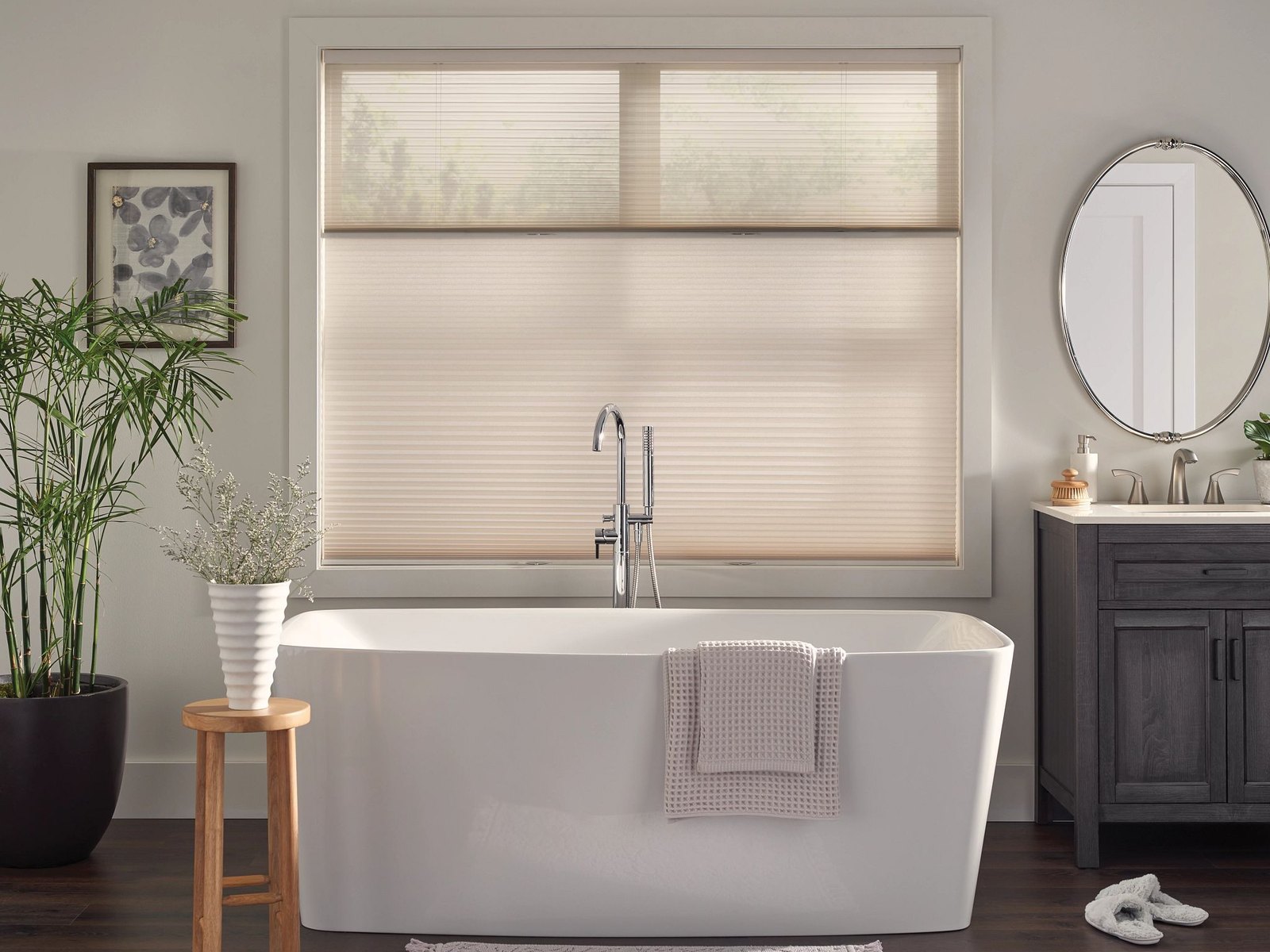
A normal shade is attached at the top and you pull it down. A top-down/bottom-up cellular is attached at both ends, so you can lower it from the top instead — or do both, and float a band of fabric anywhere in the opening.
It sounds like a gimmick until you live with the right window. A front-facing room on a street where you want daylight but not an audience. A bathroom. A kitchen window over the sink that looks straight at the neighbor's siding. You drop the shade from the top, the lower half of the glass is covered, and the daylight still comes over the top. You get privacy and a bright room at the same time, which on a standard shade is a choice between the two.
It is also the feature most often skipped at the quote and most often regretted afterward, because from a picture it looks like a detail. Ask us to show you one working on your own window and you will know in about four seconds whether you want it.
The fabric decides this, not the cell structure, and it is a separate decision from how much insulating you want.
Daylight comes through softened and the room stays bright, but shapes outside are blurred and nobody can see in during the day. The default for living rooms, kitchens and anywhere you want the room to feel open. At night, with the lights on, a light-filtering fabric gives you less privacy than people expect — worth knowing before you choose it for a front window.
An opaque fabric, often with a liner inside the cell. Daylight is cut dramatically and the room reads as dim rather than dark. The right answer for most bedrooms, a nursery where a nap has to happen at two in the afternoon, and any room with a television in it.
No cellular shade is truly blackout on its own. Light passes around the edges of the fabric where it meets the window frame, and on an inside mount that gap is unavoidable. Outside mount with real overlap cuts it a long way. If a genuinely dark room is the goal, read our page on blackout shades and let us talk you through it.
Bedrooms, bonus rooms, home offices, any room above a garage, and every window where comfort matters more than the window being a feature. They are quiet, they are light, they operate easily, and they do not draw attention to themselves — which in a bedroom is exactly what you want.
They are a weaker answer where the window is part of how the room looks. A cellular shade is a clean, modest, functional thing. In a formal dining room or a front window you want people to notice, a roman shade gives you fabric and a tailored line that a honeycomb cannot. In a room where you want the glass completely clear when the shade is up, a roller stacks smaller.
A word on wide and tall openings. Cellular fabric is light, which is an advantage — a very wide cellular is easier to live with than a very wide fabric shade. But past a certain width a single shade sags slightly in the middle over the years, and the fix is either two shades side by side or motorizing it. On a tall window with a cord you cannot reach, motorized stops being a luxury and starts being the only sensible way to use the thing.
All three are shades. The right one depends on what that particular window is for, and most houses end up with more than one kind.
Comfort is the point. The room gets too hot, too cold, or both, and you want the window covering to be doing something about it rather than just hanging there looking correct.
You want the glass completely clear when the shade is up and the view uninterrupted. Simpler, stacks the smallest, and the natural home for solar fabric on a hot west-facing room.
The window is part of how the room looks. You want fabric, texture and a tailored line, and you are willing to give up a completely clear pane of glass to get it.
On the right window, yes — most noticeably on a west-facing room in summer and next to old glass in winter. On a newer, well-sealed window in a shaded room, the honest answer is that you are buying a nice shade and the insulating part is a bonus. We will tell you which of those your window is.
Yes, and on any window a child or a pet can reach we recommend it without hesitation. Cordless and motorized lifts remove the hazard rather than managing it. More on window covering safety.
Vacuum gently with a brush attachment, and blow dust out of the cells with a hair dryer on cool or a can of compressed air. Spot-clean carefully and test somewhere hidden first. Do not soak a cellular shade — water inside the cells is very hard to get back out and the fabric can lose its crease.
A well-made cellular holds its shape for years. What does happen on very wide shades is a slight sag across the middle, and on anything unusually wide we will raise that at the measure and suggest splitting it into two rather than letting you find out later.
Both, with the right hardware. A vertical cellular runs side to side across a slider and keeps the insulating benefit on what is usually the worst glass in the house. Skylights and angled windows are their own conversation and almost always want a motorized lift, because nothing else reaches.
Most houses end up mixing on purpose — cellular where comfort matters, blinds or shutters where the look does. If matching across rooms matters to you, say so at the measure and we will plan the whole house at once instead of one window at a time.
Between us, thirty years in the Treasure Valley — in and out of Valley homes. Angela grew up in her family’s shutter plant and opened her own here in Idaho in 2020. She can build a plantation shutter start to finish and paint it herself — which is exactly why she knows what to look for in the ones we install.
We’re not a franchise. The people who measure your windows are the same people who own the company.
If you’re ready, fill out the form below and either one of us will get right back to you. Call, text or email — whichever you prefer.

Tell us which windows you're covering and we'll bring samples, measure, and put a real number in front of you. Free, and no pressure. Prefer to talk? Call 208.755.8583.
Rather not fill in a form? Call or text us — whatever is easiest for you.
That number takes texts as well as calls. On a computer, point your phone camera at the code — a text to us opens already written, so all you do is hit send.
Or send your details below and we will come back to you.
We work directly with Treasure Valley builders and new-construction agents on whole projects — single homes to full developments — on schedule and to spec. Star, Kuna, Meridian, and Eagle are some of the fastest-growing new-construction markets in the Treasure Valley, and it is where a large share of our work happens. Whether it is shades for one spec home or window coverings across an entire subdivision, we build the schedule around your build schedule, not the other way around.
We coordinate around your build timeline, not the other way around.
Every unit gets the same construction-grade fit, home after home.
Direct communication with the owners, start to finish.